JusticeForRosie.org · Care counts

Rosie’s Law gives others
the choice she was denied.

To be seen as family, not divided as property.

Rosie is still waiting for that same justice.

Justice for Rosie is a movement to protect companion animals and the people who care for them. Rosie’s story inspired a new legal path in Illinois. This is the life behind the legislation—and the mission carrying her legacy forward.

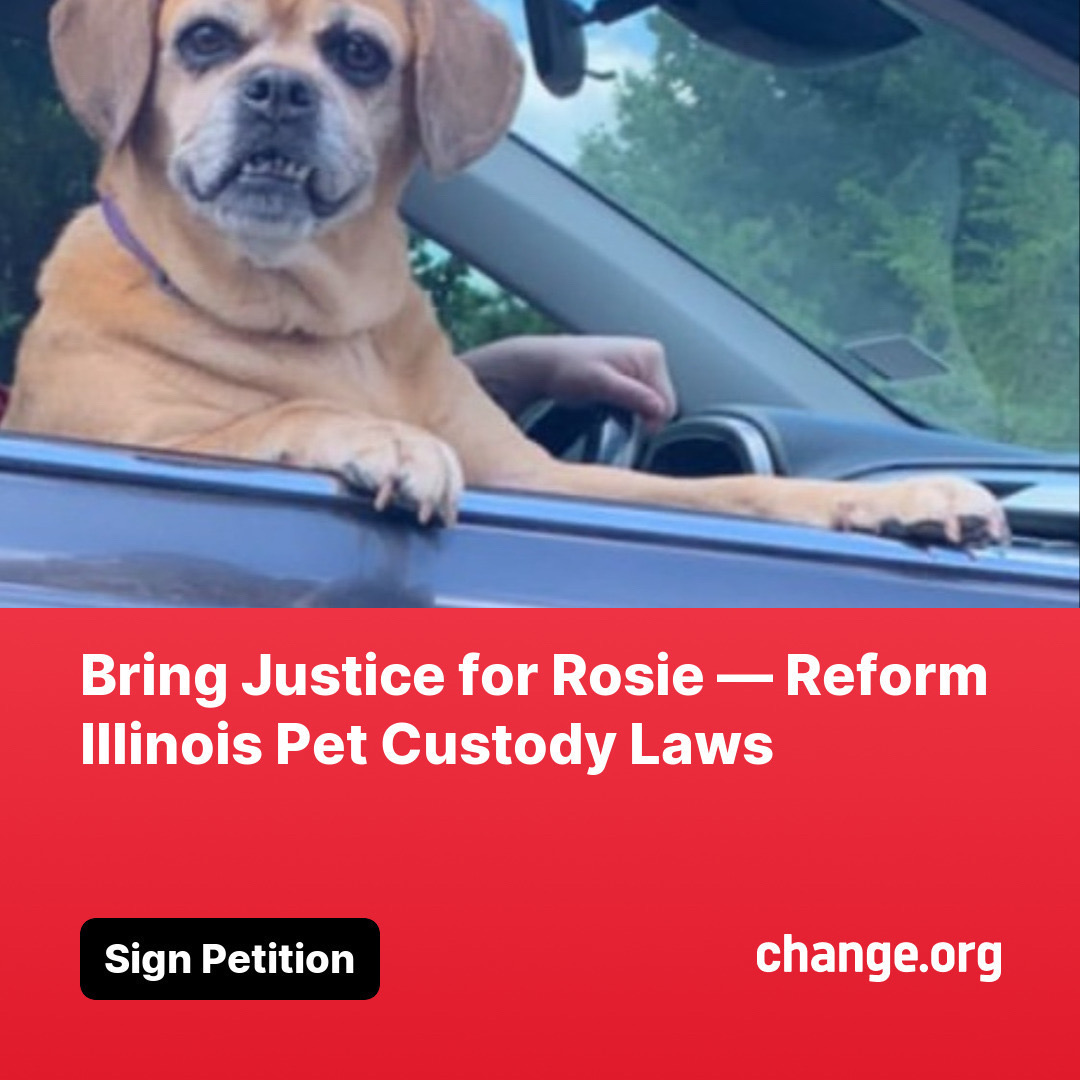
Rosie, a senior tan Puggle, leaning from a car window above the original Justice for Rosie petition message
Rosie in the carThe original petition image that helped carry her story

Our mission

Protecting the bond between companion animals and the people who truly care for them.

Justice for Rosie

We preserve Rosie’s story, explain the legal gap her case exposed, and advocate for decisions grounded in caregiving, continuity, safety, attachment, and animal wellbeing.

Rosie’s story

A small dog. A profound bond. A law that had to change.

Rosie is a senior Puggle with a crooked little smile and a gift for making herself part of every room. She followed me through the house and pressed close whenever I sat down. While I met with clients, she slept beneath my work desk or curled up behind me, where clients could see her—and hear her snoring. Her snoring became such a familiar part of the workday that I eventually bought noise-canceling headphones.

For more than half of her life, I shared the daily care at the center of our bond: meals, walks, veterinary appointments, insurance, medication, comfort, and the quiet repetition through which an animal learns where home is.

After my long engagement ended, Rosie remained primarily in my care, continuing the routine we had established over the years. In March 2025, she was removed. My requests for her return, mediation, visitation, and continued contact did not reunite us.

This story can be told without turning anyone into a public character. Its focus is Rosie: the life she lived, the relationships she formed, the care she depended upon, and the legal system that had no meaningful way to consider her wellbeing.

What the record establishes

Care was documented in more than memory.

Veterinary recordsLicensing & insuranceReceipts & care costsPhotographs & videoWitness statementsRequests for contact

Documented fact

Veterinary records document an enlarging left-leg mass in 2025 and cytology consistent with a mast cell tumor in April 2026. The later clinical history reports that the mass had doubled in size and was causing pain and substantial limping.

Personal experience

Tameer believes the abrupt loss of routine and contact caused Rosie emotional distress. The records document changes in Rosie’s health, but do not by themselves prove a single cause.

A personal narrative

What silence cost.

For nearly a decade, I regarded many of these friends and relatives as my own family. When Rosie was taken, I reached out—not asking anyone to choose sides, but asking people who had witnessed our bond to help preserve it.

Some left the conversation without responding. Others dismissed me outright. One person told me, in unmistakable terms, to “eat a dick.”

They did not have to agree with every part of my story. I was asking them to acknowledge what they had seen: Rosie knew me, depended on me, and loved me. Their refusal to speak became part of the silence surrounding her removal.

I tried private requests, mediation, visitation, witness packets, and every process I knew how to follow. When those efforts failed, documentation became advocacy. What some people called dramatic became a contemporaneous record of a bond the legal system could not meaningfully see.

“I’m not doing this to be right. I’m doing this because Rosie is Light.”
“The work didn’t end. It changed.”

Inside the hearing

October 9, 2025 · Maywood, Illinois

Six years of caregiving. Four years of documented care. Thirty minutes to be heard.

Tameer did not go to court claiming that affection alone entitled her to someone else’s dog. She brought a replevin case asserting a superior present right to possession—supported by years of daily custody, financial responsibility, medical decision-making, and Rosie’s established life with her.

01

The legal question

Who had the stronger present right to possession?

Illinois replevin law distinguishes possession from title. Tameer’s case focused on the life Rosie was actually living: who cared for her, paid for her needs, coordinated treatment, maintained her routines, and held responsibility for her welfare.

02

The record she brought

Care documented across years and institutions.

The evidence included veterinary and rehabilitation records, insurance, licensing, food purchases, care expenses, correspondence, photographs, video, and witnesses who had personally observed Rosie’s daily life and attachment.

03

What happened that day

Delay narrowed the story the court heard.

According to the appellant’s account, the hearing began more than an hour late. Rosie’s sitter, groomer, and neighbors had appeared to testify, but several had to return to work. Their sworn statements were then excluded as hearsay.

04

The framework that prevailed

Historical acquisition eclipsed present care.

The ruling centered on an account that Rosie had been acquired earlier and on language in Tameer’s pro se complaint describing the other party as the “legal adopter.” Tameer’s appeal argues that this substituted a first-in-time ownership theory for the required inquiry into present possessory rights.

246

pages in the central exhibit binder, within a broader record of four binders

Not a claim built on emotion alone

The evidence traced responsibility, not merely proximity.

  • Medical care resumed and coordinated beginning in 2021
  • Veterinary payments and physical-rehabilitation records
  • Pet insurance and a city dog license in Tameer’s name
  • Twenty-one documented purchases of Rosie’s specialized food
  • Witnesses to daily custody, routine, and attachment

The appellant’s account

Contrary records were excluded—and then the claim was called uncontroverted.

Tameer offered shelter and veterinary records challenging the alleged ownership chain, including records identifying another original adopter and a later transition out of that family’s care. Those records were excluded as hearsay. The written order then described the other party’s earlier ownership as “uncontroverted.”

The imbalance at the center

Photographs showed association. The binders showed caregiving.

The other side relied primarily on an account of earlier acquisition, photographs, and witness testimony. Tameer’s appeal argues that the court did not meaningfully weigh her documented medical, financial, licensing, insurance, and daily-care record against those photographs.

The written order · November 4, 2025

The court found that Tameer “failed to meet her burden of establishing that she had an immediate right to possession of Rosie.”

What the judgment did not mean

The judgment did not establish that Tameer was a stranger trying to claim someone else’s animal. It reflected the limits of a property-based framework that gave no independent legal voice to Rosie’s bonds, routines, continuity of care, or wellbeing.

This account draws from the written court order and the appellant’s filed account of the hearing.

Rosie’s Law · HB 4540

Care now counts.

Signed by Governor JB Pritzker on July 24, 2026, the Companion Animal Custody Equity Act gives Illinois courts a modern framework for covered companion-animal possession disputes. The law takes effect January 1, 2027. The Public Act citation will be added when it appears in the Illinois General Assembly record.

View the official bill history ↗

Before

A gap for unmarried families

Illinois divorce law could consider a companion animal’s wellbeing. Unmarried co-caregivers facing a possession dispute did not have an equivalent statutory framework.

Now

A legal path centered on care

Courts can evaluate the real history of caregiving, attachment, environment, and wellbeing—not only who first possessed an animal or whose name appears on a document.

What courts may consider

A fuller picture of an animal’s life.

  1. 01

    Who provided food, water, shelter, and daily care

  2. 02

    Who arranged and paid for veterinary treatment

  3. 03

    The animal’s relationship and emotional bond with each person

  4. 04

    The stability and safety of each proposed living environment

  5. 05

    Documented caregiving history and the animal’s established routines

  6. 06

    Temporary caregiving or limited visitation when needed to reduce disruption

The timeline

One year changed the law. Rosie’s story began long before it.

Select a chapter to see what the available record establishes.

01Before March 2025A life built around care
Documented history

For years, Rosie’s days were shaped by familiar rooms, walks, veterinary appointments, shared routines, and the person she followed from room to room.

02March 2025Rosie was removed
Case record

The relationship ended in early March. During the weeks that followed, Rosie remained primarily in Tameer’s care, consistent with the daily routine established over the years. In late March, Rosie was removed from the home where she had remained. Her return was requested. She did not come back.

03Summer 2025New health concerns were recorded
Veterinary record

Veterinary records documented digestive illness, house-soiling, eye and anal-gland concerns, and an enlarging mass on Rosie’s left hind leg. Fine-needle aspiration was recommended in July 2025 but declined. The records establish the symptoms; they do not establish a single cause.

04October 9, 2025The evidentiary hearing
Appellant’s account

Tameer came to court with witnesses and an extensive record of daily care, medical coordination, financial responsibility, licensing, insurance, and Rosie’s established routines. According to the appellant’s account, the delayed hearing caused several witnesses to leave for work; their sworn statements were then excluded, and the case was resolved through a framework centered on alleged historical acquisition rather than the full caregiving record.

05November 4, 2025The written ruling
Court record

The court entered judgment for the defendant, finding that Tameer had not established an immediate right to possession. The written findings emphasized alleged historical acquisition, excluded contrary records as hearsay, and treated language in the verified pro se complaint as a judicial admission.

06November 2025An offer to fund cancer screening
Preserved communication

Tameer offered to pay for Rosie to be screened for cancer. The request was declined. This event is presented from the preserved communication and Tameer’s contemporaneous account.

07April 23, 2026A mast cell tumor was identified
Veterinary record

Cytology was consistent with a mast cell tumor, a malignant cancer in dogs. The clinical history reported that the mass had doubled in size, become firm and warm, and was causing significant pain and limping. Wide surgical excision, histopathologic grading, and lymph-node evaluation were recommended.

08January — May 2026Heartbreak became legislation
Legislative record

HB 4540 was filed, advanced through committee, passed the Illinois House 72–38, and passed the Senate 52–7.

09July 2026The medical uncertainty became known
Veterinary record

Records obtained by Tameer documented Rosie’s April diagnosis. They show temporary treatment for pain, inflammation, and possible infection, but do not establish whether the recommended surgery, histopathology, staging, or other cancer treatment occurred.

10July 24, 2026Rosie’s Law was signed
Legislative history

Governor JB Pritzker signed HB 4540, the Companion Animal Custody Equity Act. Beginning January 1, 2027, courts can consider caregiving, bonds, living conditions, and animal wellbeing in covered possession disputes.

Rosie today

The law changed. The ending did not.

In June 2026, after more than a year without contact with the circle of friends and family she had once considered her own, Tameer says she had a “bad feeling.” She began reaching out for one simple assurance: confirmation that Rosie was still alive. About a month later, the answer arrived—a two-second video of Rosie and a text that read, “Yes, this convo is over.”

By July 30, 2026, Rosie and Tameer had been separated for nearly 500 days. During that separation, Rosie—a senior dog—had been diagnosed with a mast cell tumor and recommended for surgery. She remained apart from the person she had followed and relied on for half her life. Nearly 500 days is not just a number. For a senior dog, it is a meaningful portion of a life.

Veterinary records obtained by Tameer show that Rosie was diagnosed in April 2026 with a mast cell tumor, a malignant cancer in dogs. The mass on her left hind leg was reported to have doubled in size, become firm and warm, and caused significant pain and limping.

The records show temporary treatment for pain, inflammation, and possible infection while diagnostic testing was underway. They do not establish whether Rosie later received the recommended surgical excision, histopathologic grading, lymph-node evaluation, staging, or other cancer treatment. The absence of those records does not prove that treatment never occurred; it means Tameer cannot verify that it did.

Rosie’s current daily life remains unknown to Tameer beyond the limited records and updates made available to her. She continues to hope for humane contact, accurate health information, and closure centered on Rosie’s welfare.

About canine mast cell tumors · Cornell University ↗

This story is shared not to punish another person, but to preserve the truth of a bond—and to help other animals avoid an abrupt, legally invisible separation.

There is no greater grief than not knowing.

Carry the story forward

Rosie changed Illinois.
Her legacy can travel farther.

Share her story. Help another state recognize that continuity of care, attachment, and animal wellbeing belong in the conversation.